
Accepting applications until August 1

City of Hope Intensive Course in Genomic Cancer Risk Assessment

Accepting applications until August 1

← Back to Virtual Meetings

ISOPT CONGRESS - JUNE 2026

Day Two: ISOPT Annual Meeting

Jun 13, 2026 Hong Kong
The 2nd Annual ISOPT Congress features world-class speakers discussing: 1) initiatives to reduce cancer mortality in Europe, Korea, and China, 2) the global cancer burden; 3) advances in neoadjuvant therapies for lung, colorectal, breast, and melanoma,; 4) multidisciplinary management of gastrointestinal, breast, and lung cancers; 5) principles for cancer prevention and early detection of colorectal, gastric, and lung cancers, and 6) the cost-effectiveness of nasopharyngeal cancer prevention and early detection.
Clear

Cancer Risks and Initiatives to Reduce Cancer Mortality

Initiatives for Reducing Cancer Mortality in Europe 16:38

Initiatives for Reducing Cancer Mortality in Europe

Isabel T. Rubio

Europe holds a tenth of the world's population and a quarter of its cancer cases. Dr. Isabel Rubio, past president of the European Society of Surgical Oncology, walked through what the Europ...

Europe holds a tenth of the world's population and a quarter of its cancer cases. Dr. Isabel Rubio, past president of the European Society of Surgical Oncology, walked through what the European Cancer Plan has actually changed since 2021, and where the gaps still cost lives. One in two Europeans will be diagnosed with cancer in their lifetime, and about half of new cases still have limited or no early screening.

Rubio's talk is a clear-eyed audit of prevention and early detection across the continent. She credits the European Cancer Plan for real regulatory and screening gains on HPV, alcohol, tobacco, and the major screening programs, then holds up the map that keeps recurring in her slides: deep disparities between Western, Eastern, Northern, and Southern Europe. The through-line is that better screening only pays off when it reaches everyone and connects to the full diagnosis and treatment pathway.

Key points for clinicians:

  • HPV vaccination is a live target. Under the EU program to eliminate HPV-related cancers, Iceland, Portugal, and Norway have reached 90 percent coverage in girls by age 15, while some Eastern countries still run no vaccination program at all.

  • Alcohol is a named, quantified risk. It accounts for about 1 in 10 cancers in men and 1 in 33 in women and is a risk factor for at least seven cancers. A 19,000-participant study across 14 countries found bottle warning labels were perceived as raising public awareness of that risk.

  • Screening has expanded and diversified. Breast screening now runs age 45 to 75, alongside expanded cervical and colorectal programs, plus three new pilots: PRAISE-U for prostate, SOLACE for lung using low-dose CT, and TOGAS for gastric via H. pylori screening and surveillance of precancerous lesions.

  • Lung screening data favor women. In the SOLACE low-dose CT program, 55 percent of participants were women, and women appear to benefit most from this approach.

  • Participation is its own barrier. In Spain, breast screening has run since the 1990s, yet first-call uptake sits near 80 percent and follow-up calls fall below 60 percent.

  • The burden is concentrated. Breast, colorectal, cervical, lung, prostate, and gastric cancers account for 53 percent of all new European cancer cases and half of cancer deaths in 2024, with a total economic impact estimated at over 100 billion euros per year.
Multidisciplinary Management of Primary Cancers: Current Standards of Care

Multidisciplinary Management of Early Breast Cancer

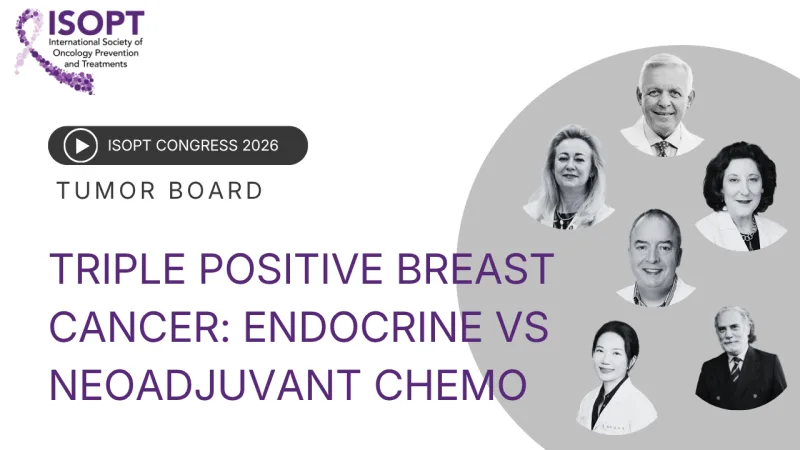
Tumor Board for a 2cm 3+ breast cancer - Endocrine therapy vs. neoadjuvant chemo 9:43

Tumor Board for a 2cm 3+ breast cancer - Endocrine therapy vs. neoadjuvant chemo

Isabel T. Rubio

A 50-year-old woman walks in with a screen-detected, clinically node-negative tumor just over two centimeters. It is HER2 3+, ER and PR positive, Ki-67 of 67, grade 3, germline negative. The...

A 50-year-old woman walks in with a screen-detected, clinically node-negative tumor just over two centimeters. It is HER2 3+, ER and PR positive, Ki-67 of 67, grade 3, germline negative. The whole panel discusses: what do you give before anyone operates?

This tumor board works through a case that sits right on the line where guidelines change behavior. The tumor is barely above the two-centimeter ESMO threshold for neoadjuvant therapy in HER2-positive disease, so the discussion becomes a live argument about how far to de-escalate. One panelist offers primary endocrine therapy and defends monitoring the response within a month. The rest of the room pushes back and lands on preoperative HER2-directed treatment, because treating first teaches you how the tumor behaves and lets you tailor everything that comes after. The value of this session is watching experienced clinicians disagree in the open and still converge.

Key points for clinicians:

The case is a 50-year-old, perimenopausal, screen-detected tumor of roughly 2 to 2.5 cm, clinically node-negative, HER2 3+, ER/PR positive, Ki-67 of 67, nuclear grade 3, with negative germline testing. It sits just above the size threshold where neoadjuvant therapy enters the conversation.

  • One panelist argues for primary endocrine therapy as a legitimate option even here, monitoring within a month to see if the tumor is shrinking. Most of the room would not choose that path for a HER2 3+ tumor.

  • The majority favor preoperative therapy, citing NCCN language that neoadjuvant treatment can be considered for T1c and larger tumors because the neoadjuvant setting reveals response and lets you optimize post-neoadjuvant treatment.

  • GAIN-2, presented at ESMO Breast, is cited as hypothesis-generating rather than definitive: HER2 3+ tumors showed high pCR rates with trastuzumab and pertuzumab alone, supporting THP over more intensive chemotherapy for a small, node-negative tumor.

  • On de-escalation, one panelist would drop the neoadjuvant size threshold below the guideline two centimeters, to 7 to 8 mm with high-risk features, while noting that lower-risk tumors with a higher chance of pCR argue for less intensive, less toxic regimens. Antibody-drug conjugates earn their added 10 to 15 percent relative pCR benefit mainly in larger tumors.

  • On the recipe, this patient would not be a DESTINY-Breast11 (DB11) candidate. The preferred choice is THP with paclitaxel rather than docetaxel, sparing carboplatin, using cold gloves and booties to limit neuropathy and nail loss, with rescue therapy decided after surgery. The panel flags the open question of whether residual disease here justifies 14 cycles of trastuzumab deruxtecan, given she does not cleanly meet DESTINY-Breast05 (DB05) criteria.

  • The panel closes on process: check for an available clinical trial before committing to any regimen.

Sponsors