 19:44
19:44
Cost-Effectiveness of Nasopharyngeal Cancer Prevention and Early Detection
Victor Ho-Fun Lee
We already have tools that catch nasopharyngeal cancer early. Professor Victor Lee spent this talk on the harder question: which screening approach is worth paying for across millions of peo...
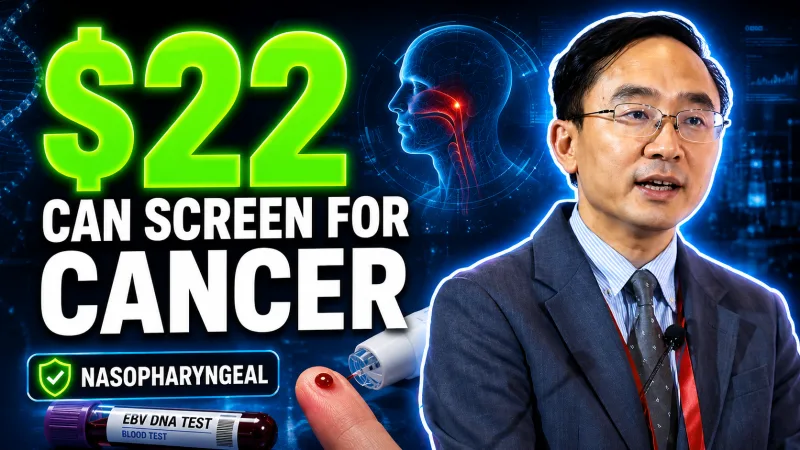
We already have tools that catch nasopharyngeal cancer early. Professor Victor Lee spent this talk on the harder question: which screening approach is worth paying for across millions of people. His answer starts with a number. The most cost-effective validated strategy runs about $22.47 per test, and in the modeling, any screening beats no screening for survival.
Nasopharyngeal cancer is geographically concentrated in the Greater Bay Area (China), Southeast Asia, and North Africa, and the differentiated type is tightly linked to Epstein-Barr virus. Lee walks through how plasma EBV DNA, discovered at the Chinese University of Hong Kong in 1998, became the backbone of NPC screening, where it still falls short, and how cost and screening interval decide whether a program is feasible for a population of millions. He closes with the work coming out of his own department: a finger-prick blood test and a 3D-printed nasal brush meant to move screening and recurrence detection out of the lab and toward the point of care.
Key points for clinicians:
In the CUHK prospective study, more than 20,000 healthy individuals were screened between 2012 and 2016 using a two-step plasma EBV DNA protocol, reaching 97.1% sensitivity and 98.6% specificity and shifting detection toward stage 1 and 2 disease with better progression-free survival.
Plasma EBV DNA still misses up to about 20% of stage 1 NPC, because the earliest tumors may not shed enough circulating DNA to be detected regardless of how much blood is drawn.
Positive predictive value is the weak point. Recent transient EBV infection and even colder ambient temperature can raise readings. NGS-based fragmentomics, which targets the shorter tumor-derived DNA fragments described by Dennis Lo in PNAS 2018, improves PPV from roughly 11% to about 20%, at higher cost per test.
Transient elevations should not be dismissed. On follow-up, people with a transiently positive result carried a relative risk of future NPC above 4, and those with persistently elevated levels reached roughly 16.8.
The BNLF2B antibody, reported from a Zhongshan cohort of more than 25,000 people in the New England Journal of Medicine, lifted positive predictive value from about 10% to 44.6% compared with VCA IgA, and may be complementary to plasma EBV DNA.
On cost-effectiveness, a JNCI analysis drawing on more than 180 studies found that PCR-based plasma EBV DNA followed by endoscopy when positive was the lowest-cost method at $22.47 per test. Annual screening yields the most survival benefit but is expensive at population scale, so every two to three years is the more practical interval for high-risk regions, with screening most cost-effective starting around the 50 to 60 age of onset.
Current limits are turnaround and recurrence. PCR takes two to four days and targeted sequencing about two weeks, and plasma EBV DNA is far weaker at detecting recurrence. Lee's group is developing a finger-prick point-of-care test for recurrence with reported sensitivity and specificity approaching 95 to 100% and results in about 20 minutes, plus a 3D-printed nasal brush to improve tumor cell capture.