 21:45
21:45
Pregnancy and the Young Breast Cancer Patient
Hee Jeong Kim
A 34-year-old woman finishes treatment, interrupts her endocrine therapy to try for a baby, and two years later still cannot get pregnant. Dr. Hee Jeong Kim opened with that case because it...
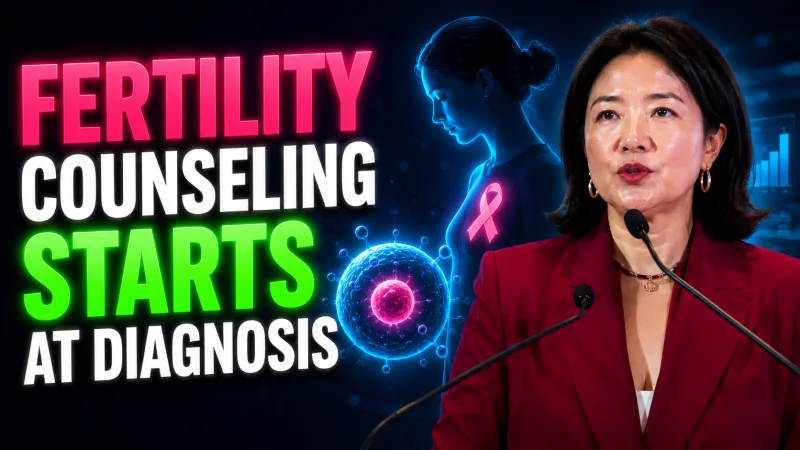
A 34-year-old woman finishes treatment, interrupts her endocrine therapy to try for a baby, and two years later still cannot get pregnant. Dr. Hee Jeong Kim opened with that case because it is the one too many clinics reach only after the window has closed. Her argument is simple and hard to ignore: the conversation about fertility has to start on the day of diagnosis, not years into treatment.
Dr. Kim, a breast surgeon at Asan Medical Center speaking on behalf of the Korean Breast Cancer Society, lays out why young women are a distinct clinical population and what it takes to protect both their survival and their chance at a family. Young women under 45 make up about 19 percent of breast cancer worldwide and roughly 30 percent in the Korean registry, and they have historically carried worse survival. Adding ovarian function suppression to endocrine therapy has narrowed that gap, but longer and more intensive treatment collides with the years these women would be building families. The talk moves from that tension to concrete practice: fertility preservation before treatment, ovarian function suppression during chemotherapy, safe interruption of endocrine therapy, and the real-world barriers that keep good options from ever being offered.
Key points for clinicians:
Young women under 45 are about 19 percent of breast cancer cases worldwide and about 30 percent in the Korean breast cancer registry, with historically higher mortality on SEER data. Because amenorrhea is associated with improved survival, ovarian function suppression added to tamoxifen (studied since 2003 in Europe and 2009 in Korea) has consistently shown a survival benefit.
Breast cancer survivors report a 60 percent lower chance of getting pregnant, driven by chemotherapy, extended endocrine therapy, and fear of recurrence. Yet in the POSITIVE trial population, 36 percent of young patients reported interest in pregnancy within five years of diagnosis.
The POSITIVE trial showed that interrupting endocrine therapy after two to three years to attempt pregnancy did not compromise safety, and that fertility preservation at the time of diagnosis raised the pregnancy rate roughly 2.4 times. The practice lesson is to start fertility and pregnancy counseling at diagnosis, not later.
Ovarian function suppression given concurrently with chemotherapy roughly doubled ovarian preservation and pregnancy rates versus controls, without a survival penalty. Random-start ovarian stimulation with an aromatase inhibitor to limit estrogen exposure, followed by a GnRH agonist, allows egg retrieval without delaying chemotherapy.
The barriers are as much systemic as biological. In a US survey of oncologists willing to enroll patients on these trials, more than half still felt uncomfortable recommending that women stop endocrine therapy, and across Asian and Latin American surveys the top barriers were time constraints, no referral system, treatment delay, and cost. Among BRCA carriers, the 10-year pregnancy rate was 22 percent in one series and only 10 percent at Asan, partly because prenatal diagnosis is not permitted in Korea.
Dr. Kim's myBC study, a shared-decision-making program for young women with breast cancer, has enrolled 11,000 patients prospectively plus 5,500 retrospectively, using decision aids, patient-partner research, and even a metaverse symposium for women who cannot easily leave work. It has since expanded into myHOP for young people with all cancers, reframing the goal as life course oncology: fertility, pregnancy, parenting, survivorship, and return to work as one continuous journey.